
How to Search Criminal Dockets
Start with New Mexico Case Lookup, the free public tool. It searches case summaries for district, magistrate, and municipal courts. Know your court before you type. Check the citation, notice, or filing for the court name. Felonies and other district-level cases generally sit with the First Judicial District Court. Misdemeanors, DWI, traffic matters, and felony preliminary hearings may land on a Rio Arriba magistrate docket instead. City ordinance cases can be municipal.
Searching by full case number beats a name search when you have it. A name alone works. Pairing it with the filing year, court type, case category, and Rio Arriba location makes the result far cleaner. What comes back is a summary and event history. It is not a promise that every document image opens. Read the most recent event first. A new notice or reset can replace an older hearing entry.
- Open Case Lookup and choose a name or full-number search.
- For a district criminal matter, enter the district court, Rio Arriba location, criminal category, and year or sequence shown on the notice.
- For a magistrate or municipal matter, select that court type and confirm the location with the court named on the citation.
- Open the matching case summary and read the status, newest docket events, and next setting.
- Call the clerk for a document, certified copy, or confirmation that the public view does not supply.
Note: Similar names crowd a result list. Compare the court, case number, and filing date before trusting an entry as your Rio Arriba criminal case.
Rio Arriba Criminal Case Codes
Case numbers carry meaning, and the First Judicial District clerk’s case-number explanation spells it out. In the legacy format, D marks district court. 117 is the Rio Arriba location. CR flags a criminal category. That makes a number like D-117-CR-2026-00001 a strong district criminal search key. Match the year and sequence to your notice exactly. Older cases follow different conventions. The printed number on your paperwork stays the safest bet.
Magistrate criminal entries swap in an M court component with the Rio Arriba code. Municipal matters may use U in the legacy system. They also require the current municipal location selection. These codes do real work. They keep a Rio Arriba criminal docket search from blending a district felony with a magistrate case or a city violation.
Use the notice first. Its court name and full number identify the best search path when several Rio Arriba criminal cases have the same party name.
What a Criminal Docket Shows
A public Rio Arriba County criminal docket can display the case number, court location, and filing date. It may also show the category, assigned division or judge, and current status. Party roles and counsel may appear too. The event list might include a filing or arraignment. Motions, responses, hearings, pleas, orders, judgments, disposition, appeals, and resets can all appear there. One caution: a listed document does not prove its image is public. Charge summaries, bond information, and attorney data also vary with the public view.
| Case number | District criminal numbers commonly use the Rio Arriba pattern D-117-CR-year-sequence; magistrate matters use an M component. |
|---|---|
| Case status | Shows whether the case appears pending or closed, but the final event explains the actual result. |
| Charge or event | May summarize an offense or identify a filing. Obtain the charging paper from the clerk if the public summary lacks detail. |
| Setting | Can show date, time, event type, location, or remote method where published. A newer notice controls. |
| Disposition | Look for the judgment, order, or disposition entry rather than inferring an outcome from a closed status. |
A docket is just a timeline. The paper behind it is another matter, and the First District filing-and-document guide explains the difference from the official side. Each event names the complaint, motion, order, judgment, exhibit, or other item actually filed.
Rio Arriba Criminal Court Split
No single desk in Rio Arriba County holds every criminal docket. Adult felony and district-level matters belong to the First Judicial District Court docket. They are normally at the Tierra Amarilla location. Call the district clerk at 505-455-8335 for case information and copy instructions. The public judge listing assigns Judge Anastasia R. Martin to Division VIII. She handles Rio Arriba civil and adult-criminal work.
The two magistrate venues keep their own criminal dockets. They cover misdemeanors, DWI, traffic, and felony preliminary hearings. Española magistrate takes calls at 505-984-3955; Chama magistrate at 505-984-3975. Española and Chama municipal courts separately handle city petty misdemeanors, DWI or traffic matters, and ordinance cases. Whatever court the citation names gets the first call.
The official judicial-assignment listing names the public Rio Arriba adult-criminal assignment.
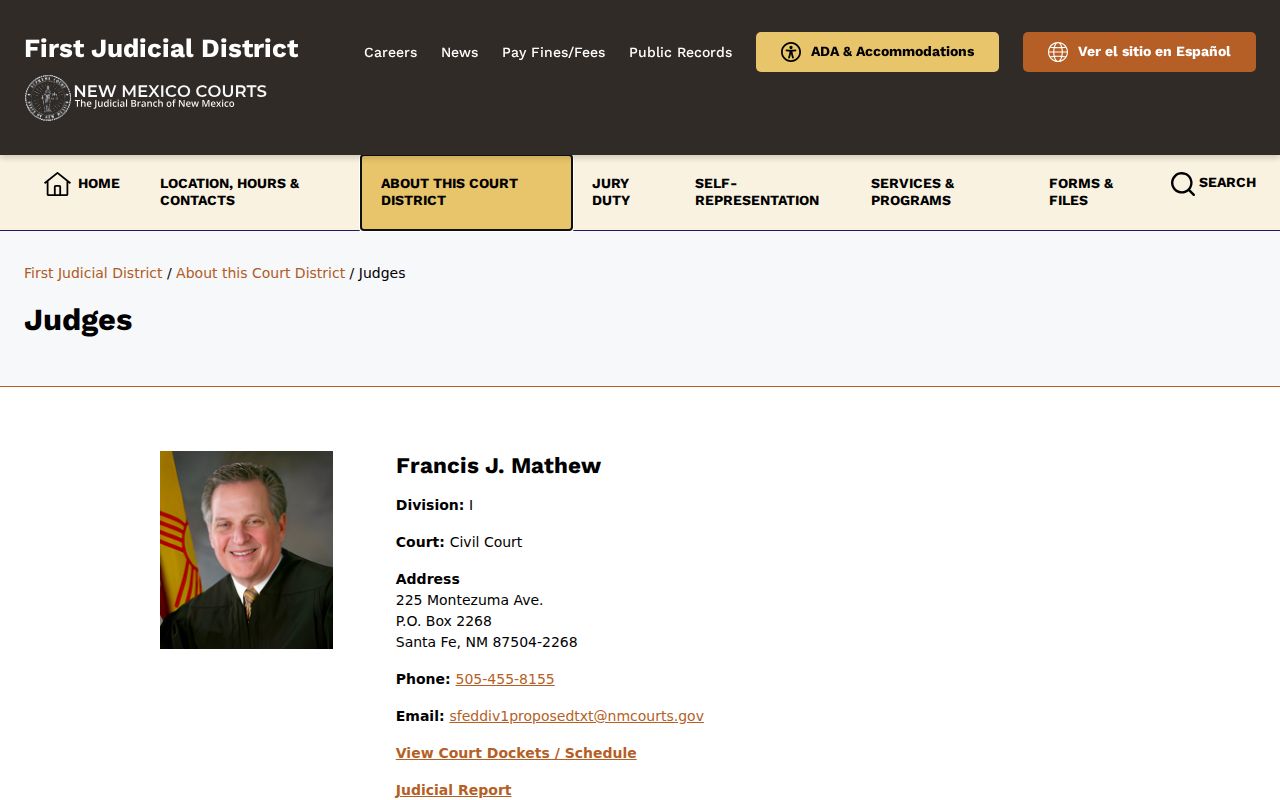
That assignment is why the court and division fields in a Rio Arriba criminal docket matter. Confirm both before relying on a setting or requesting a court record.
Stages on a Criminal Docket
A criminal register usually opens with a charging or initiating document. Arraignment and counsel or appearance filings come next, then discovery and motions. Later entries can record a hearing. A change of plea, trial, order, judgment, sentencing, disposition, appeal, or post-judgment action may follow. Magistrate docket labels take a different path. They may start with a citation. Arraignment, plea, trial, judgment, and MVD-related events come next.
Docket flow: Charge Filed › Arraignment › Pretrial Settings › Plea or Trial › Judgment or Disposition › Sentencing
A setting is a scheduled event, not a result. “Filed” means a paper was submitted, not granted. “Closed” just means the status reads closed. For how the case actually ended, read the judgment or disposition entry: dismissed, resolved by plea, decided after trial, or closed some other way.
Rio Arriba Criminal Motion Terms
The action words in a Rio Arriba criminal docket carry real weight. A motion is just a written request. It asks the court to decide something. It is not a ruling. Paperwork from the other side appears as a response or reply. When the judge acts, you will see an order entered. A Notice of Hearing gives you the date, time, place, and method of a proceeding. Spot a reset or continuance? That means an earlier setting moved. Do not treat the old one as current.
- Arraignment
- An early criminal appearance where a charge and plea process are addressed.
- Pretrial
- A case-management stage before trial or disposition.
- Change of plea
- A setting for entering a plea, distinct from a final judgment entry.
- Disposition
- The recorded final result or case-closing action. Read its related judgment or order when available.
These definitions describe docket language only. They say nothing about the merits of a case. If a public event label confuses you, the clerk can explain how to request that document without giving legal advice.
Rio Arriba Criminal Plea Rules
Division VIII publishes procedures that shape how a Rio Arriba criminal setting gets prepared. These never appear as event entries. Per the Division VIII schedule, a complete plea packet must be in hand before any change-of-plea setting. The packet includes the signed plea agreement and the sentencing worksheet. So a docket entry requesting a plea hearing does not prove that requirement was met.
The same instructions set other deadlines. Exhibits are due at least 48 hours before a hearing or trial. Remote participants should join five minutes early. Interpreter requests should come within five days at 505-455-8290. For the actual location or remote method, rely on the current Notice of Hearing. Do not assume a recurring division procedure fits your specific case.
Rio Arriba Criminal Reset Check
A reset on a Rio Arriba criminal docket is a signal, not an answer. Start by reading the entries that come after the original setting. Look for a new Notice of Hearing. Also look for a continuance, an amended notice, or a scheduling order. The newest record might give the new date. It might only note that the old date was vacated. Match it against any notice you already hold. Still unclear? Call the clerk or your attorney.
The First District schedule page lists a Wednesday Rio Arriba felony docket remote line, but verify it before relying on it. That page is general schedule information. It cannot replace a private case notice. It is also not permission to enter another proceeding.
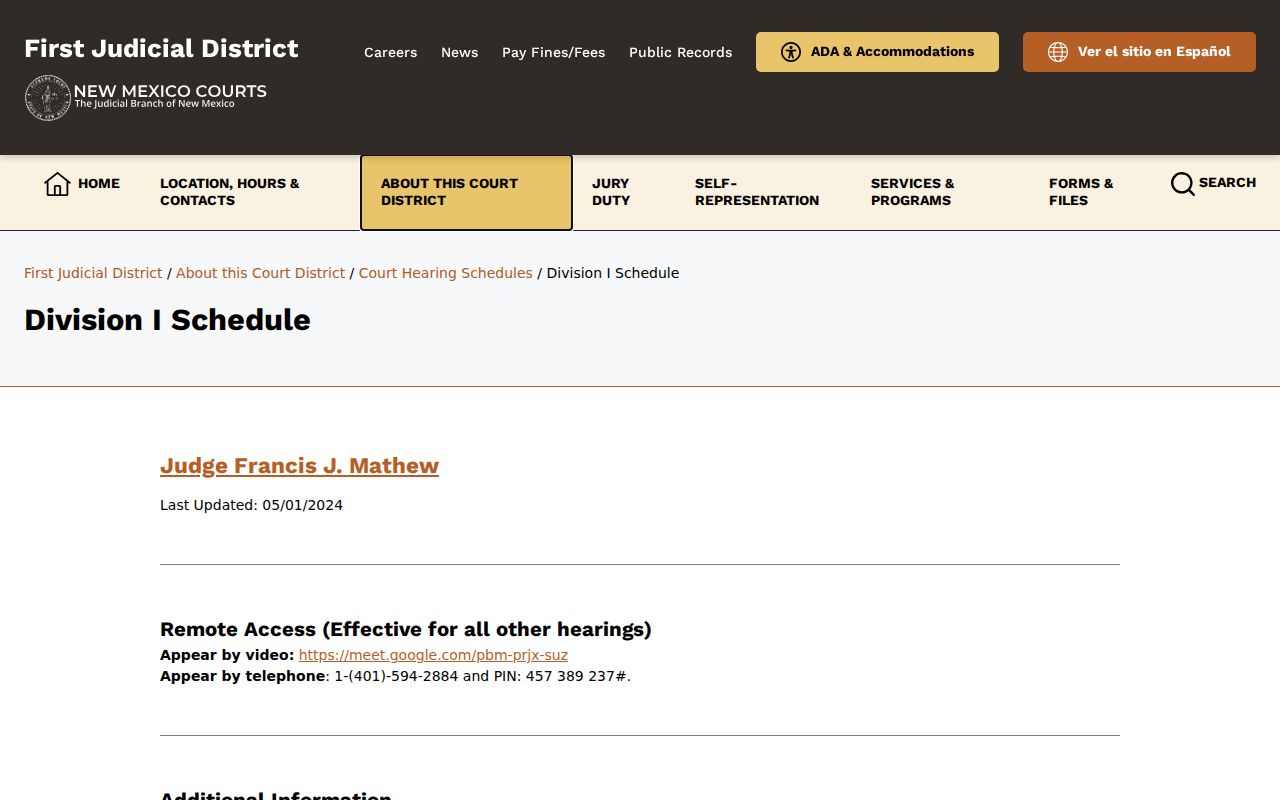
The published schedule shows why a hearing that moved demands more than a Rio Arriba criminal docket search. The individual court notice still governs.
Which Court Holds Criminal Dockets
Criminal dockets in this county sit in different places. The New Mexico magistrate court listings and First District materials lay out the split. Adult felony and district-level criminal dockets belong to the First Judicial District Court. The Española or Chama magistrate clerk handles limited-jurisdiction criminal proceedings. For local ordinance and municipal traffic matters, use the municipal court printed on the citation. Each court keeps its own docket. Each keeps its own file, too.
| Rio Arriba venue | Typical criminal docket | First route |
|---|---|---|
| First Judicial District Court | Adult felony and district-level criminal matters | Case Lookup, then district clerk |
| Española or Chama Magistrate | Misdemeanors, DWI, traffic, felony preliminary hearings | Case Lookup, then the relevant magistrate clerk |
| Española or Chama Municipal Court | City petty misdemeanors, traffic, and ordinance cases | Municipal court or the current municipal location in Case Lookup |
Sometimes you must move between these courts. A name search can come up empty in one venue yet miss a case sitting in another. A missing result there proves nothing about whether a different Rio Arriba criminal court has filed one.
Rio Arriba Criminal 2026 Pilot
A new First Judicial District criminal case-management rule is now in place. It covers Rio Arriba criminal cases filed on or after January 1, 2026. The July 2025 Judiciary release explains the discovery and motion deadlines. The goal is to move criminal cases toward trial in roughly seven to ten months. Only the most complex ones sit outside that pace. Keep perspective, though. This is procedural context, not a prediction about any one case.
The New Mexico Judiciary news archive holds dated court announcements. Those include the public news image that follows this page section.
A dated announcement can explain why procedures changed. The Rio Arriba criminal docket still shows the actual entries in each case.
Public Access and Sealed Criminal Dockets
New Mexico court records are open as a rule. A Rio Arriba criminal docket can still leave things out. Material that is sealed, confidential, protected, or limited by rule or order may not appear. The public online search specifically bars juvenile criminal cases and Family Violence Protection Act orders. Case Lookup can also list an event while withholding the document image. A no-result can mean many things. It could be the wrong court, a spelling error, an older file, CAPTCHA trouble, migration timing, or a restriction.
Case Lookup cannot always deliver a public document you need. Then contact the clerk who keeps the file. You can also make a particularized request through the New Mexico Judiciary IPRA form. Identify the court location, the case number, the record type, and a clear description. IPRA does not override a seal, a confidentiality statute, or a court order.
Key Rules:
Rule 1-079 NMRA treats docket entries as court records while protecting specified personal identifiers and restricted material.
Final Case Access Policy describes online access tiers, redaction limits, and the exclusion of sealed or confidential material.
NMSA 1978, Section 14-2-8 request route uses a written request with a reasonable description through the official Judiciary form.
Rio Arriba Criminal Access Limits
Seeing a docket entry is not the same as seeing the whole file. Under the online policy, document access depends on digitization, redaction, user profile, and implementation. Odyssey courts scan paper records filed on or after January 1, 2015. Even so, not every image becomes public. Older Rio Arriba criminal files may still live elsewhere. They may sit in paper files, bound books, or local indexes. For anything before 1997, ask the clerk about the historical-record request route.
Never ask a clerk to bypass a seal. Instead, ask whether a redacted version exists. Ask what rule or order controls. Ask whether a motion or court order is required. That keeps the line clear between an available docket entry and confidential case material.
Rio Arriba Criminal Treatment Cases
Rio Arriba County runs an Adult Treatment Court under the First District. The program has a public line at 505-753-8933. Call it for questions about how the treatment court works. The criminal case behind a participant's enrollment usually keeps its normal district or magistrate case number. That number stays on the regular court docket.
Details are thinner than you might hope. Participant records and treatment assessments can be restricted. So a public Rio Arriba criminal docket rarely shows what stage of the program someone has reached. Read the docket as a case history, not a treatment record.
For a standard criminal docket question, work in order. Start with Case Lookup. Then try the court named on the case, then the clerk who keeps the record. That keeps your docket search anchored to real filings, the current hearing setting, and the court's own access rules.